The Wisdom of Disappointment

“We must surrender our hopes and expectations, as well as our fears, and march directly into disappointment, work with disappointment, go into it, and make it our way of life, which is a very hard thing to do.” - Chögyam Trungpa

If you’re like most humans, you’ve done everything possible to avoid feeling disappointment, perhaps even built your entire life around experiencing it as little as possible.

Perhaps you do one of two things: 

You keep your life small which means avoiding having hopes, dreams or expectations: 

I’m fine like this. I just want a simple life. I don’t want to want anything because then I’ll never be disappointed. It doesn’t really matter to me anyway:

If I don’t open my heart to anyone, then I won’t be hurt. 

If I don’t have ambition, then I never have to put myself out there and risk being disappointed.

As researcher and writer Brené Brown says, this is about choosing to live disappointed in a low grade kind of way rather than risk feeling disappointed in a bigger way at certain moments in life. 

The second possibility looks very different: Striving for perfection, in an effort to avoid failure and disappointment: If I do everything right, I’ll never make a ‘wrong’ decision so I’ll never have to feel disappointment.

Avoiding Disappointment

How does it make sense that we might have learned to protect ourselves from disappointment in these ways (and others)? Chances are, as a child, we experienced disappointment as extremely painful:

x Perhaps we were criticised by care givers or teachers when we did something wrong, and the feeling of being a disappointment felt unbearable. 

x Perhaps a parent’s disappointment in us was interpreted as there’s something wrong with me, I am not worthy, I will be abandoned - which felt unbearable.

x Perhaps our parents said something like: I’m not angry at you, I’m just disappointed and that cold feeling was even worse than anger.

x Perhaps we felt our parents’ disappointment in their own lives, not necessarily through words but through what we picked up on.

x Or perhaps we were disappointed by parents who couldn’t show up for us in the ways we needed them to when we were children.  

Even if experienced only once, it makes sense that we would come to the (unconscious) conclusion: It’s too painful to feel disappointed so I must avoid it in any way I can.

And so we built our internal villages to avoid ever feeling this ‘dangerous’ emotion again, even at a very high cost.

Yet what we resist, persists. Again, Brené Brown: 

“When we deny our stories and disengage from tough emotions, they don’t go away; instead, they own us, they define us.”

Being Willing to Feel Disappointed

Instead of being unconsciously ‘defined’ by avoiding disappointment, I want to suggest something that may seem counterintuitive: 

While never easy to feel, disappointment can actually be a very wise guide.

The etymology of the word disappointment comes from the old French desapointer: dis- reverse, opposite of + appointer - to appoint, which is a form of choosing. So literally the old French desapointer means to un-appoint or as I interpret it, to un-choose.

So I see the role of Disappointment Villager in our internal villages as simply telling us that something in our current reality is not working for us and that we may need to un-choose in some way. 

This un-choosing does not mean having to completely give up or let go. It isn’t an all or nothing thing. What it might be signalling is that something in our current reality has not worked out, and this could be an expectation, a belief, a dream, an ideal, a part of ourselves or a way of doing things.

Disappointment says nothing about our value as a human. In fact, if we are open to life, and fully experiencing the messiness of being human, if we are putting ourselves out there and opening our hearts, then disappointment is inevitable and unavoidable because we can’t control everything.

The Gap

Imagine walking along a path. At some point you look around and realise: This isn’t where I want to be. Something isn’t right.

There’s a gap between where you are and where you want to be, or had hoped to be.

Hello, Reality vs Expectation.

Allowing disappointment can look like: 

x Stop. Allow yourself to feel disappointed without resistance. After all, it is not your enemy, simply a messenger with some important information. Hello, Disappointment.

x Take stock of the current situation with curiosity (not judgement). What is this feeling telling me?

x Re-calculate: Un-choose what no longer works and re-choose what feels more aligned.

So disappointment steps in and helps us admit the current reality is not working in some way. It allows us to be honest about our reality IF we can avoid going into blame or wallowing, which can actually be a way of avoiding the more difficult task of taking responsibility.

It helps us take stock of the situation: What isn’t working for me here? What part of this am I disappointed about?

It helps us re-connect to values and re-calculate how to keep moving towards them, like a GPS: What does this tell me about what really matters to me? How else can I keep moving towards these values, perhaps in a different, more realistic way? Do I need to adjust my expectations? Do I need better boundaries or self-care? Do I need to admit that the current reality does not meet my needs and adapt in some way? Do I need to walk away?

Disappointment allows us to land in reality with a thump: This is where you are. Stop. Take stock. Re-evaluate.


Afterall, as Psychologist Les Greenberg says: "You can't leave a place until you've arrived."

By doing this, disappointment helps us re-shape reality in a way that can be helpful, it helps us figure out where we go next.

For example, disappointment may tell me: There is a gap between my desire for intimacy and connection and my actual relationship. This does not mean getting rid of my values around intimacy and connection. It does not even necessarily mean letting go of the relationship. When I can allow myself to sit with disappointment, I find that on the other side are creative solutions, new possibilities, new paths that I could not see before listening to disappointment.

So I might decide to do something different to create more opportunities for intimacy. I might talk to my partner. I might decide to look for this more outside the relationship. I might work on my own capacity for intimacy. I might question whether my expectations are realistic.

Disappointment is not the end of the path. It’s simply a necessary stop that can help us take stock, un-choose what doesn’t work and re-choose what feels more aligned. 

By being willing to feel disappointment instead of trying so hard to avoid it, we dare more, risk more, and open our hearts more - knowing that if things don’t work out, it’s OK.

When we can see disappointment as just information that can help us to un-choose and re-choose, we no longer need to build our lives in an attempt to avoid it.

A reality check

I think we all have unrealistic expectations of life, of ourselves and of other people, and this gap between our expectations and the reality of life and what it means to be a messy human can lead to a lot of unnecessary suffering.

David Richo outlines these five core challenges that we all face yet are often in denial of:

Everything changes and ends.

Things do not always go according to plan.

Life is not always fair.

Pain is part of life.

People are not loving and loyal all the time.

These are the core challenges that we all face. But too often we live in denial of these facts. We behave as if somehow these givens aren’t always in effect, or not applicable to all of us. But when we oppose these five basic truths we resist reality, and life then becomes an endless series of disappointments, frustrations, and sorrows.” - David Richo, The Five Things We Cannot Change: And the Happiness We Find by Embracing Them

Everything is My Fault

“We can actually reconstruct our past by examining what we think, say, feel, expect, believe, and do in an intimate relationship now.” - David Richo, When the Past is Present

It’s my fault. I’m to blame. Feelings of guilt or shame. Feeling overly responsible for everything. Feeling like doing what I want hurts others and / or leads to them rejecting me.

If this feels familiar to you, perhaps you grew up in a family where you had to unfairly carry a parent’s emotions, needs or expectations.

One of the roles of the caregivers is to help the child get to know their own internal village of thoughts, emotions, needs. This allows them to feel they are separate individuals, that they are allowed to have their own emotions, needs and desires and that they are not responsible for their parent’s well-being - their emotions needs and desires.

social media.001.jpeg

This ideal scenario can sometimes get distorted, and one of the most common ways this happens is when the child is made to feel overly responsible for what is happening in one or both of the parents’ villages.

This injustice can happen in overt ways by a parent who says / does things like:

It’s your fault I’m upset.

I’ve made all these sacrifices for you, you’re so ungrateful!

Shame on you!

You’ve made mum angry again, you’re a bad child!

If you don’t do this, I’ll be sad / disappointed

If you loved me, you would…

Being scapegoated.

And it can also be a lot more subtle, not so much in what is said, but in what is felt and concluded on an unconscious level by an often sensitive child:

When I do something I want to do that mum doesn’t approve of, she looks angry / sad / disappointed.

I can’t disappoint mum the way dad does.

Dad looks so proud when I do what he expects of me! I need to suppress my own desires and do what he wants of me.

Everything is so tense all the time, I should be able to fix things!

Mum is so fragile I am afraid she will break if I express my needs or emotions. I must become needless.

social media.002.jpeg

attachment vs individuality

We have a strong biological drive for attachment, in the same way all mammals do. A child knows on a deep primal level that they cannot survive on their own, without their caregivers to meet their (physical) needs.

Yet we also have a need to be our own person, to inhabit our own village: this is the need for individuality, authenticity, a sense of self.

If both aren’t possible, if a child doesn’t feel they can be themselves and still be cared for, then attachment always wins because it is about survival. Individuality / authenticity is suppressed in order for the child to adapt to the caretaker and stay in attachment.

social media.003.jpeg

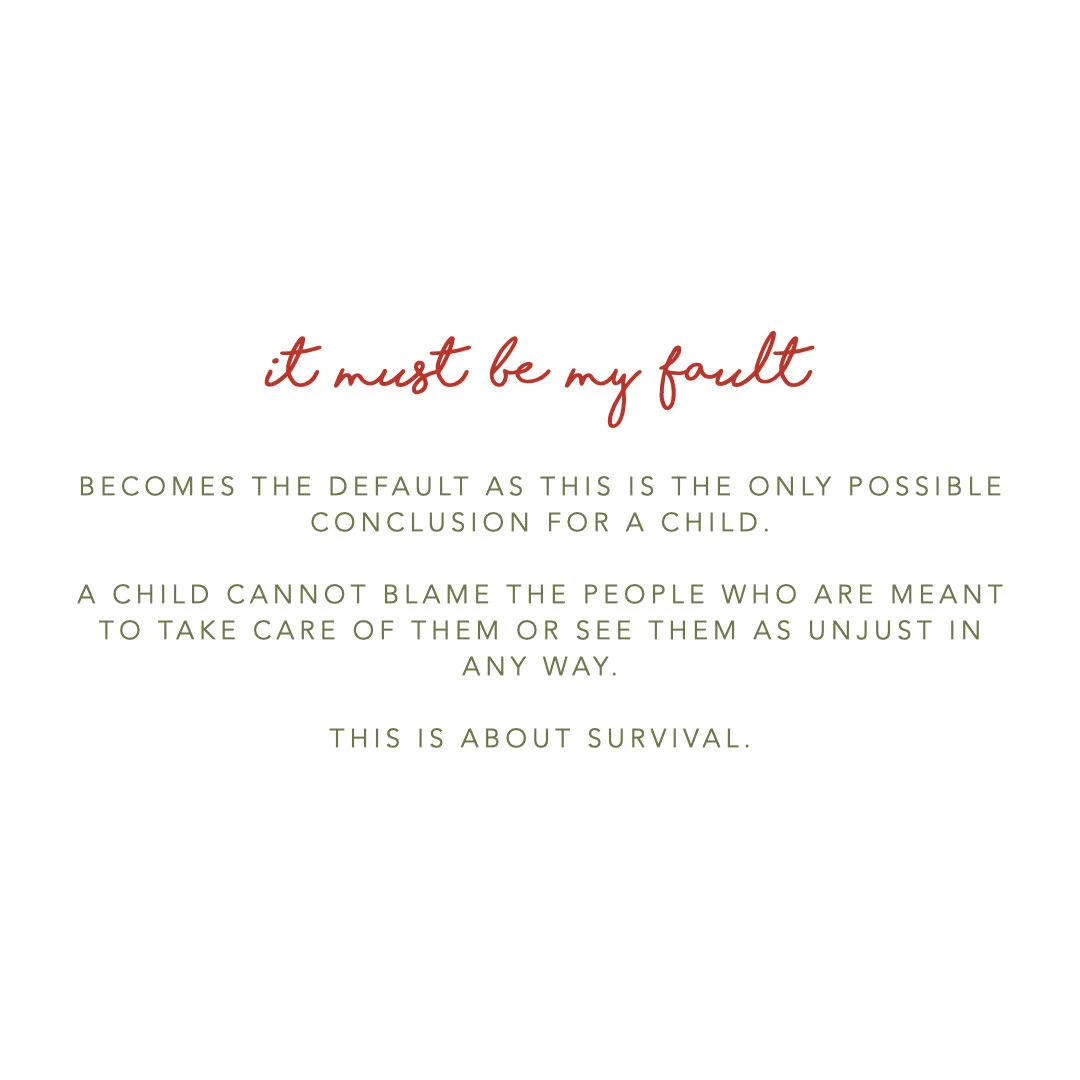
Until about the age of about 10, children tend to blame themselves for any forms of mistreatment or injustice that happens to them because it is inconceivable for them to blame the people they rely on for their physical survival.

I must have done something wrong. It must be my fault. I am a horrible person. I am not enough.

It’s my fault becomes the default.

social media.004.jpeg

this spills into adulthood

Experiencing situations like this creates a distorted view of reality, where as adults we feel overly responsible for other people’s villages - and are particularly sensitive about our ‘impact’ on them, fearing our choices might harm others.

This dynamic spills over into adult relationships, as our ‘blueprint’ for what to expect from relationships has been formed from childhood.

It leads to adults who feel they are doing something wrong by doing what is best for them, especially if it goes against others’ expectations of them.

It leads to adults who sacrifice their own needs to take care of others.

It leads to adults constantly apologising for everything, whether or not it is actually their fault.

It leads to adults who dare not take risks or try new things because they might be blamed for failing - or blame themselves (that parent is now an inner critic).

It leads to adults who feel too powerful in some ways: Who feel they have the power to ‘destroy’ someone with their choices or emotions, because this is what they experienced growing up.

At the same time, they may feel powerless to state their needs because they believe that doing what’s best for me hurts others, disappoints them, infuriates them and then I am no longer safe or I feel even worse.

It leads to adults who feel overly responsible for others and will put up with unacceptable behavior because they ‘should’ be able to fix others or take care of them. This is often a pattern in abusive / manipulative relationships.

It leads to adults who are afraid of commitment because they feel that the impact they have on others could be harmful, or have learned that relationships = manipulation.

It leads to adults who try really hard to be beyond reproach, to be a good person and do the right thing because deep down they believe there must be something wrong with them or they must be bad if their parents blamed them. This often means holding themselves at impossibly high standards. 

Above all, it leads to a constant sense of guilt, of doing something wrong when doing what is actually right for us.

healthy guilt vs leftover guilt

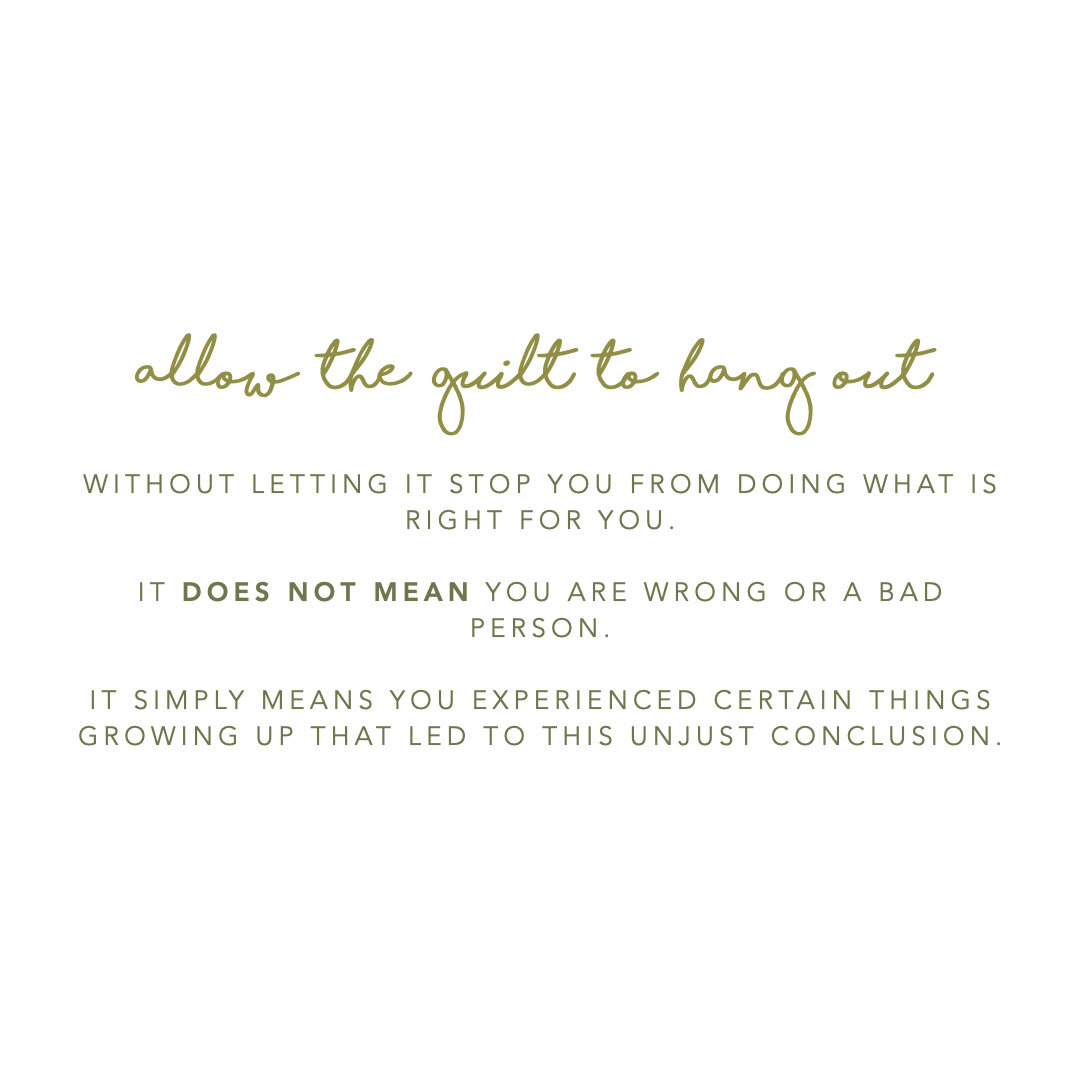
If you can relate to some of this, it’s important to recognise that it probably makes sense given what you experienced growing up that this feeling of responsibility is there, and that you may often feel leftover guilt, especially when you do what you think is best for you.

It is important to recognise that this is not the same as healthy guilt. Healthy Guilt is the internal police of the village that signals to us that we have done something that is not in line with our values.

Leftover guilt is the feeling of betraying or hurting our parents by doing what is best for us.

A good reality check when feeling guilt is to ask: Am I actually doing something wrong here (for example, by stating my needs, saying no, disappointing someone)? What would I say to a friend?

Unfortunately, Leftover Guilt is not going anywhere, even once we are aware of where it comes from. It has become a default, like a well-worn path in the woods we have walked many, many times.

What we can learn to do instead is start to create a new path, by questioning Leftover Guilt, not taking it as The Truth About Us and no longer allow it to take over the village. We can learn to make decisions based on our values instead.

reality check: a few points

You are not doing anything wrong by doing what is best for you, even if other people don't get it or agree with you.

You can't change someone's else's behavior or make them happy by erasing yourself. You are entitled to your needs and emotions, even when others don't approve or understand them.

We do not have the power to ‘break’ others by simply standing up for ourselves or taking care of ourselves. If they ARE hurt by this, it’s OK. It’s not on you. They are adults and it is their responsibility to take care of their own emotions. You were never meant to carry this burden.

Sometimes others get hurt when we go after the things we want because they have specific exceptions of who we should be. Yet as an adult, only we can be the judge of our own experience. Their expectations and disappointment belong to them.

You are allowed to make mistakes: Life is a learning process. 

Be kind to yourself the way you would be to a friend and give yourself time to heal. Choose to see the Leftover Guilt as a genius survival adaptation that allowed you to survive your childhood instead of something to get rid of (because that isn’t possible!).

Learn to become the accepting, loving parent to yourself that you didn’t feel you had as a child as you go through this process. 

Getting to know your own village, perhaps for the first time, is not always an easy process, yet it is also growth-filled and fulfilling one.

social media.006.jpeg

Find out more:

Dr Gabor Maté has this excellent short video on choosing attachment over authenticity.

On boundaries

On responsibility / power

On The Village

These books by Dr Lindsay Gibson

The Strange Wisdom of Procrastination

Putting things off does NOT mean we are lazy or are unable to manage our time. Instead, procrastination tells us that something else is going on. 

What are some of the reasons we procrastinate? Are there times when procrastination is creative? And how can we work with procrastination more effectively?

Click on the image below to watch the recording by Creative Mornings Lausanne on this topic.

I Am No Longer Who I Once Was

“The hero’s journey always begins with the call. One way or another, a guide must come to say, 'Look, you’re in Sleepy Land. Wake. Come on a trip. There is a whole aspect of your consciousness, your being, that’s not been touched. So you’re at home here? Well, there’s not enough of you there.' And so it starts.” - Joseph Campbell

We know on some level that life happens in chapters, that change will be a part of our lives. Yet there are moments when it feels like everything has been overturned, that nothing makes sense anymore, and we are often left stunned.

Stunned by the upheaval, the questions, or even just the need for something to change we suddenly seem to be facing. How, what we worked so hard to build, no longer seems to matter as much. How that gnawing sense of dissatisfaction keeps telling us something that once worked for us, no longer does.

Or perhaps we wake up to a longing, a desire we had never fully been in contact with before but now feels urgent. We don’t recognise ourselves anymore - we may even act in ways that feels very unlike us. Our habitual way of dealing with things seem to have abandoned us.

Often but not always, these times come with a blow from the outside world: A break-up, a burn-out, a loss of some kind, falling in love or having an affair, a difficulty we must face - and with this comes the sinking realization:

I am no longer who I once was.

Hello, Life Transition. Hello, Crisis. Hello, Opportunity.

As the quote above suggests, these moments in life can be seen as awakenings. Awakening to parts of ourselves we did not know, or had never fully known. Awakening to what is no longer working for us. And maybe, further down the road, awakening to a life that feels more authentic.

When we are in these moments of life, it can feel excruciating and never-ending. Yet looking back there is often a sense of: That was awful, but it allowed me to get to where I am today.

And while the emotional turmoil during these times is very real - often intense anxiety, sleeplessness, depression, even suicidal thoughts - they are also a normal part of being a human who is alive to their own potential for growth.

In my work as a psychologist, and also now as an astrologer, I see several key moments when people come to therapy, and that seem more turbulent than others. These are key moments to navigate these very important questions which mostly center around re-examining and perhaps re-defining: Who am I and what do I want from life?

young adulthood: around 28 / 29

In astrology, this is a very important time when the planet Saturn has made a full turn around the Sun and is back at the same place as when we were born: The Saturn Return.

The Swiss psychiatrist, Carl Jung talks about how in the first half of life we establish ourselves as individuals. This is when we typically build our careers, start a family, buy property etc. At this stage of life, we are often influenced by family and society and doing things ‘right’, climbing the corporate ladder etc. Status and achievement matter.

Then we get to 28 / 29, and something seems to shift. This is often a time of growing up, of beginning to define ourselves on our own terms, beyond upbringing / society / culture. 

We are asked to get real about what we want in areas of life such as relationships, starting a family, where we live, career, health. Often, this can be a very turbulent, difficult time, with obstacles to overcome. Once we have come out of it, it feels like there is a before and after the 30 year old mark. Those people in their 20’s now seem so young!

midlife questions: around 36-50

When we arrive at the second half of our lives, things start shifting. We have done everything society told us to do, and yet may be starting to feel unsatisfied. Is this all there is to life? What have I worked so hard for? What do I really want?

Astrologically, this is also a very busy time, particularly around the late 30’s (Pluto square Pluto), 40/41 (Neptune square Neptune) and 44/45 (Uranus opposite Uranus).

All the efforts and achievements don’t seem to matter as much as they once did. 

Instead, there is often a search for something bigger than ourselves, for meaning. We want to feel like we matter beyond our status or performance. Life no longer feels unlimited and we can start wanting to leave behind us something of value. Often this is the start of a more spiritual quest, a search for the deeper significance of our human life.

But it often isn’t a gentle process. Instead, as astrologer Howard Sasportas writes, it is:

"a time for disassembling ourselves and then putting the pieces back together again but in a different way. Parts of our nature we haven’t integrated yet into our conscious awareness, and which we have been ignoring or not looking at, demand to be acknowledged and examined. Facing the conflicts and crises of this period increases the likelihood of a fulfilling second half of life.”

‘Disassembling ourselves’ can mean letting go of the armor we have learned to wear, the ways we have learned to please others, the ‘adaptations’ to getting our needs met we had to learn in the first half of life. Often, as children, we had to sacrifice authenticity for safety simply as a way of surviving and getting our needs met. We had no other choice. We learned to people please, to perform, to do what others expect of us, to diminish ourselves - whatever was needed to ensure attachment with our caregivers.

At midlife, this no longer works. We now yearn to be seen for who we really are. We crave real connection. A part of us wakes up and starts to whisper: what if my needs also matter? who am I when I am not just taking care of others? I want to live out loud! I want to be ME.

If you consider that we all contain multitudes - different villagers in our internal village that all want different things - the conflict comes when the parts of us that prioritised safety now start to collide with the parts of us that are starting to come out of the shadow and demanding a place in our internal village.

As Carl Jung wrote:

“…we cannot live the afternoons of life according to the programme of life’s morning for what was great in the morning will be little in the evening, and what in the morning was true will in the evening have become a lie.” 

All the ways we have learned we need to be in the world now feel inauthentic. Disingenuous. This can feel very confusing and destabilizing, almost like we are losing our ‘religion’, without yet having a new ‘religion’.

We know that we can no longer be the person we once were, like clothes that have grown too small or are simply outdated - yet we do not yet know who we are to become. We do not yet have new clothes - and even worse, have no idea what we want them to look like.

later life: as of 50

In particular around the ages of 50 (Chiron Return) and then again at around 58 / 59 (Second Saturn Return) according to astrology, this is a time of questioning one’s own role as an ‘elder’ or wise person of the community. 

It is a time of questioning what adjustments are needed to ensure this final part of life is meaningful. There is often a desire to impart knowledge and wisdom to the younger generations and to act as guiding lights for improving our world. Often, old wounds that have not been fully healed might also resurface during this time and this is an opportunity to work through them.

hanging out in the liminal space

The challenge in all these moments of life is: ‘I am no longer who I once was, and not yet who I am to become.’

Doesn’t being in this in-between state help make sense of the anxiety, depression, sleeplessness, confusion, panic we might be experiencing during these times?

One of the most important ways of navigating these times, is to accept them as a natural unfolding of life, as a part of what it means to be living a life we are awake to, and perhaps to use this opportunity to move with the changes that are asking to happen, rather than trying to resist them or avoid them or even avoid reflection. The one thing we can always do is not add on extra layers of pain and instead get curious about what these emotions are trying to tell us.

During these time, we are hanging out in a liminal space: An in-between space where we are not meant to stay but simply to pass through, like corridors or stairways that are necessary because they lead from one place to another. Liminal spaces are also often seen as a sacred space, where our old selves can fall apart, and something new and bigger is revealed - almost like a rite of passage.

Just because we are feeling this way right now does not mean we will stay here forever.

The most difficult part is accepting that we cannot yet know who are to become, yet need to let go of old identities and ways of being that are no longer working. We need to trust the process that is unfolding.

In this space, can we face what needs to be faced, let go, allow transitions to happen, shift our identity, make changes that are aligned with our unique path? While these times will never feel easy or enjoyable, perhaps viewing them as an awakening to something more aligned to our soul that we have yet to uncover can help us navigate them more serenely.

We are in the habit of imagining our lives to be linear, a long march from birth to death in which we mass our powers, only to surrender them again, all the while slowly losing our youthful beauty. This is a brutal untruth. Life meanders like a path through the woods. We have seasons when we flourish and seasons when the leaves fall from us, revealing our bare bones. Given time, they grow again. - Katherine May, Wintering: The Power of Rest and Retreat in Difficult Times

Year in Review: 2020

2020. A year that needs no introduction. A year that started out normal enough and morphed into one of the most unforgettable and perhaps even transformative years many of us have experienced.

Like every year, I took a look back at what my year looked like work-wise.

a normal start…

In February, I participated once again in Victoria Sardain’s Brunch Club as one of the speakers in an event which included yoga, discussions on resolutions, goal-setting and self-sabotage, followed by brunch.

Looking back now, it feels even more precious to have been part of this event, as it was one of the few group events I attended this year.

ECCBD14A-35F4-4FF5-A39F-207627A5ED20.jpg
IMG_0718.jpg
brunch club.PNG

then the pandemic hits

Remember March? We had no idea what was happening and whether we would be safe or if there would be enough food (and toilet paper!).

Quite early on, I moved all my sessions online and this lasted about two months before doing some sessions in person again during the summer.

While I have always done online sessions, I have never done only online sessions, and this proved quite different. I quickly learned that I couldn’t do the same number of online sessions as in person ones, that I needed to space sessions out more and take more breaks. Hello, Zoom fatigue.

Nonetheless, I am very grateful to have been able to continue working throughout this time and interestingly, sessions took on a different flavor with themes such as death, the meaning of being alive, health anxiety, what really matters in life. With the Black Lives Matter movement, topics around injustice, evil, discrimination also surfaced.

This year really felt like we were all world citizens, impacted by events and movements that were larger than us. This obviously affected me also. Working from home, often in yoga clothes and going through similar experiences to what was affecting my clients, I couldn’t hide behind a role or therapy approaches. This hit even closer to home when my 84 year-old father in Jordan caught COVID (thankfully, he recovered and didn’t infect anyone else in the household).

I felt a humility and sense of really just being a human soul sitting with another human soul without even pretending to have answers or ‘solutions’. Seeing the people I work with in their home environment surrounded by their pets and plants, it all felt more real - like we no longer needed (or could) play a role.

This more human relating, stripped bare of our usual artifices showed me we are all interconnected in our humanness and not just by a global pandemic.

Our common humanness: An obsession with homemade bread!

Our common humanness: An obsession with homemade bread!

Uncovering my inner introvert

Learning to enjoy my own company has been a theme of the past few years, and this year catapulted me to the next level. I spent two weeks without seeing or talking to a real human and I was surprisingly OK.

I know that many people had similar experiences, while for others, it revealed the opposite: That they perhaps need people more than they had realized. Both good learnings in my book!

With the usual ways of topping ourselves up no longer being as easily accessible, I sought different forms of self-care and what I found most nourishing this year has been being in nature. I created a habit of going on solo walks almost daily and these became my greatest source of comfort. The wisdom of nature, the timelessness of the moon and the trees felt more ‘true’ to me than anything else, especially amidst all the uncertainty.

The holidays I took were all in the Swiss mountains and I realized how lucky I am to live in a country with such beautiful nature and to be with a man who has such an inspiring relationship to nature.

94511341-ab5c-4575-ace2-0220a4d2ca30.jpg

Inner journeying

What I missed most this year was traveling. I realized just how much I had taken for granted being able to hop on a plane and go somewhere; just how much I rely on travel as a way of recharging, seeking inspiration, broadening my horizons, being with the people I love.

With travel in the outer world not really being an option this year, I turned more inwards.

One of my passions this year was astrology. Being able to follow the astrology of 2020 was a very interesting experience in making sense of what was happening; in seeing it as a cycle, with a beginning, a middle and an end.

I started an astrology course in January to learn to interpret birth charts and just completed this. I did many readings with friends and clients to practise throughout the year. I am currently specialising in Psychological Astrology, a two-year Diploma course based on the work of Swiss psychiatrist / psychoanalyst, Carl Jung, and modern Astrology.

Astrology is a mysterious yet surprisingly concrete way of understanding who we are, a different and perhaps quicker way of learning about the important themes for us in life, as well as our strengths and struggles. For me, it is a very powerful way of connecting to something bigger than us, to the planets and moon and the seasons in a way humans have done for thousands of years.

photo by bjornrapp.com

photo by bjornrapp.com

my own growth

I also continued with my own therapy, working with a therapist who focuses more on the unconscious / depths of what it means to be human. Becoming more and more interested in this approach and the work of Carl Jung, I had the great fortune of visiting his house in Küsnacht, near Zürich in a guided tour given by one of his granddaughters.

I also continued to invest in supervision and training, focusing particularly on Coherence Therapy, a powerful way of changing habits and behaviors where we previously felt stuck.

Coherence Therapy is based on research in memory reconsolidation, the only known neural mechanism that allows long-ingrained, learned behavioral and emotional reactions / beliefs that drive behavior to be ‘unlearned’. This is often done by repeatedly reading a statement based on an ‘emotional truth’ we uncover during session. Most of the people I worked with this year will have noticed the use of statements after sessions becoming a regular addition!

I felt that I needed to update my website with these newer ways of working, and in December I updated the look and content of this website.

I always try to integrate the body in my personal work, and this year I found working with Leena Rose Miller, a medical intuitive in the USA who regularly comes to Switzerland, particularly helpful.

blogging + other resources

I focused mostly on social media this year and only write a few blog posts.

My personal favorite and the most liked post this year was one I wrote in February: This Isn’t Working for Me Anymore. This is about what I later called soul whispers: That knowing which often doesn’t make rational sense and yet cannot be ignored if we want to live an authentic life.

The blog post that seems to have struck a chord with people most is this one on emotional neglect, When Love is Not Enough - something invisible that touches many of us despite well-meaning and loving parents.

During my birthday weekend in the mountains, my partner helped me create this free video series on my concept of The Village: A metaphor for our internal world comprised of thoughts, needs, emotions - all represented by different villagers.

Turning 40

This year I also turned 40. I shared the photo and post below on Instagram and Facebook which feels like a fitting theme of the year around embracing the messiness, the unknown, the uncertainty of life.

photo by bjornrapp.com

photo by bjornrapp.com

40.jpg

our common humanness

If there's anything this crazy year has shown me, it's how interconnected we all are: Not just through a virus, but through our shared humanness.

This year, I experienced how this shared humanness can allow us to be more real, more open, more human with each other. That we can be broken and messy, and that maybe that is how we can connect to each other, instead of playing a role.

This year stripped our lives down to the essentials: What really matters when so much is taken away? I really hope that as we (hopefully) resume a more ‘normal’ existence, we never lose sight of this question or take for granted the stuff that brings meaning to our lives.

Thank you for being a part of this messy, beautiful adventure with me! I no longer know what to wish for for the coming year, so I will simply say: Thank you, 2020. You have shown us we can handle more than we think. And welcome, 2021. Please be gentler with us.